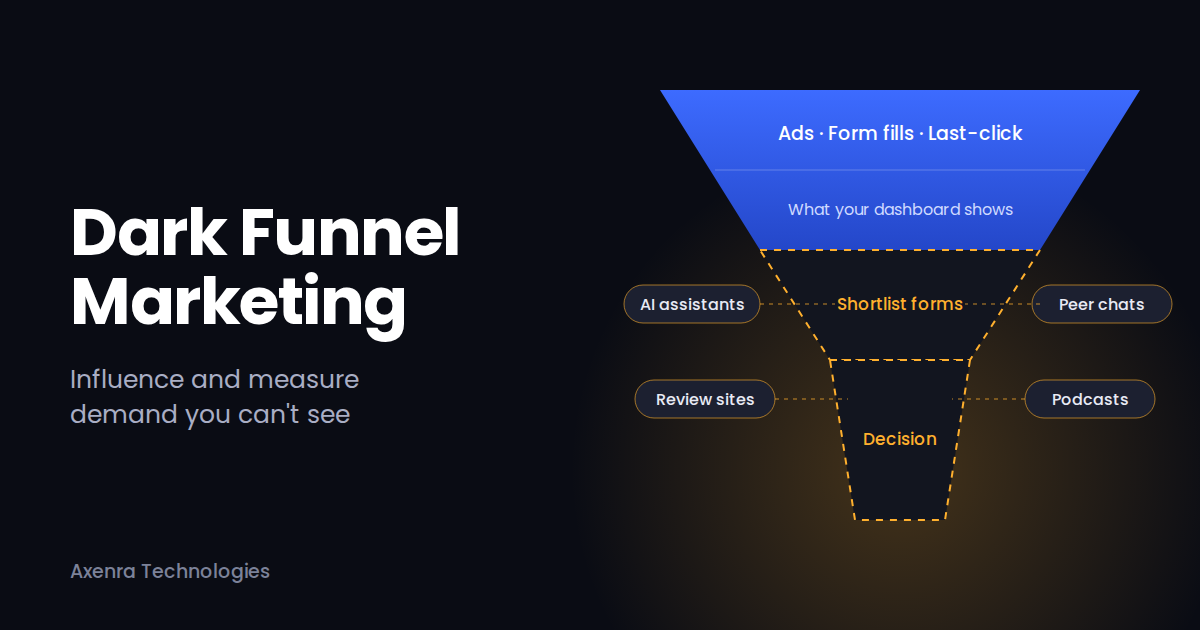
Your dashboard says 400 leads this quarter. Your sales team says half the people they speak to already knew exactly which vendors they wanted to evaluate, and you were one of three. Where did that opinion form? Not in any report you can open.
Welcome to the dark funnel: the research, conversations and comparisons that shape B2B buying decisions long before anyone fills in a form. Understanding dark funnel marketing is now essential for CMOs, heads of growth and performance marketers who want to compete where decisions are actually made, and measure their influence honestly.
This guide explains what the dark funnel is, where it happens, why your current reporting misses it, and how to influence and measure it with a practical 30-day starter plan.
What the dark funnel is, and why it is growing
The dark funnel(also called dark social or the invisible buyer journey) is all the buyer activity you can't track with standard attribution tools. It includes reading peer posts, asking colleagues in private chats, watching a podcast, checking review sites, comparing vendors in an AI assistant and discussing options in Slack or WhatsApp groups.
It isn't new. Word of mouth has always existed. What's changed is its scale and importance in B2B SaaS:
Gartner's Buyer Research Insight
Gartner's buyer research is often cited for the finding that B2B buyers spend only a small portion of the buying journey, around 17% by its estimate, in meetings with potential suppliers, with the rest spent researching and aligning internally.
The takeaway for marketers: the part of the journey you can measure is getting smaller relative to the part that decides outcomes.
Where B2B buyers research before contacting you
If you want to compete in the dark funnel, start by mapping where it happens. For most B2B SaaS categories, the main places are:
AI assistants and AI search
Buyers ask questions like “best [category] tools for [use case]”and get a summarised answer with a handful of vendors. If you aren't described accurately, or at all, you are out before you begin. This is the heart of the B2B buyer journey with AI.
Peer networks and communities
Private Slack groups, LinkedIn conversations, industry communities, WhatsApp groups and founder circles. Recommendations here carry heavy trust and leave no trace.
Review and comparison sites
G2, Capterra, TrustRadius and similar platforms influence shortlists, often without a click to your site being attributed to them.
Social content and video
Buyers read LinkedIn posts, watch YouTube explainers and listen to podcasts without ever visiting your website.
Analyst, media and newsletter coverage
Industry newsletters, analyst notes and trade publications build familiarity and credibility.
Branded search
Buyers still search, but increasingly for your brand name after learning about you elsewhere. Branded search B2B behaviour is often the visible footprint of invisible influence.
What your dashboard misses
Most marketing reports are built around what is clickable and trackable. That creates a distorted picture of demand.
Last-click attribution over-credits the final step
When a buyer types your brand into Google and fills a form, 'organic search' or 'direct' gets the credit, while the podcast, peer recommendation or AI answer that created the intent gets none.
Form fills measure conversion, not influence
A form fill shows the moment someone chose to identify themselves. It says little about what shaped the decision.
Gated content reports flatter the bottom of the funnel
Gating assets raises lead counts but hides the people who would have read the content and never filled a form, often the earlier-stage researchers you most want to reach.
Channel reports reward what's easy to track
Paid campaigns with clean tracking can look efficient, while brand-building activity looks wasteful, even when it feeds the demand that paid captures.
Budget decisions follow the data
If reports understate the impact of brand, content and community, those get cut first, which shrinks future demand further.
The result: A misleading picture, shaky budget decisions and a brand that gradually disappears from shortlists without any alarm going off.
How to influence the dark funnel
You can't track every touchpoint, but you can show up in the places where decisions form. Four levers matter most.
01Clear positioning
If buyers can't summarise what you do and who you are for, they can't recommend you. Write a plain-language positioning statement (what you do, for whom, and the outcome) and use it consistently on your website, profiles and sales material. Specific beats clever.
02Citable content
Create content that buyers, peers and AI tools can quote and reference: clear definitions, direct answers, original data, frameworks, honest comparisons and detailed case studies. Structure matters too, with descriptive headings, short paragraphs and FAQs. Ungated is usually better for early-stage research content, since the goal is influence, not capture.
03Third-party proof
What others say about you carries more weight than what you say about yourself. Invest in:
- Customer reviews on platforms buyers use
- Case studies & testimonials with real metrics
- Partner and integration ecosystem listings
- Podcast guest spots, webinars & roundups
- Analyst briefings and credible press mentions
04Community presence
Show up where your buyers talk. That might be founders sharing practical lessons on LinkedIn, teams answering questions in industry communities, or subject-matter experts publishing opinions. The aim is to be useful and recognisable, not promotional.
How to measure the dark funnel
You can't measure it perfectly, but you can measure it honestly. Combine several imperfect signals rather than chasing a single perfect number.
1. Self-reported attribution
Self-reported attribution simply means asking buyers how they heard about you. Add an open-text field to your demo and contact forms: “How did you first hear about us?” Open text is far better than a dropdown because it captures the unexpected answers (“a friend's WhatsApp group”, “ChatGPT”, “a podcast I can't remember”).
Implementation steps:
- Have sales ask the same question on the first call and log the answer in your CRM.
- Categorise responses monthly into themes (AI tools, peers, review sites, social, events, search).
- Compare self-reported sources with system-reported ones. The gap is your dark funnel.
2. Branded and direct search trends
Rising branded search and direct traffic, particularly when it follows a content push, campaign or community activity, can signal growing awareness. Track branded impressions and clicks in Google Search Console, and watch the ratio of branded to non-branded demand over time.
3. Pipeline influence
Shift reporting from lead volume to pipeline and revenue influence. Look at:
- Win rate and deal velocity by self-reported source
- Share of opportunities where buyer already knew your brand
- Pipeline created by segment after brand & content investments
- Sales feedback on how prepared and informed prospects are
4. AI-answer checks
Create a set of 20 to 30 prompts your buyers might use (category, problem, comparison and brand questions). Run them across major AI assistants each month and record whether you appear, how you are described and which sources are cited. Treat it as a share-of-voice tracker for AI research.
5. Directional experiments
When possible, test the effect of brand and content activity at a market level: for example, launching a growth content series or review campaign in one segment or region and comparing branded search, inbound conversations and pipeline against a similar segment.
None of these signals alone is conclusive. Together they give you a far more truthful picture than last-click alone.
Common mistakes
A 30-day starter plan
Form Setup & Baseline Metrics
- Add a mandatory open-text “How did you hear about us?” field to your main forms.
- Brief sales to ask and record the same question on first calls.
- Pull 90 days of branded search and direct traffic trends as a baseline.
- Run your first set of AI-answer prompt tests and save the results.
Positioning Clarification & Ungating
- Write or tighten your one-sentence positioning statement.
- Audit your top 10 pages for clarity, definitions and structured answers.
- Identify one or two gated assets that could be opened up.
Social, Review & Community Activation
- Ask five happy customers for specific reviews on the sites buyers use.
- Pitch two podcasts, newsletters or partner webinars.
- Pick one community or LinkedIn format where your experts can contribute weekly.
Synthesize Themes & Scale Decisions
- Review self-reported attribution themes alongside system-reported data.
- Re-run AI-answer tests and compare with week 1.
- Present leadership with a simple view: visible demand, reported influence and what you plan to scale.
The point of the first 30 days isn't to solve attribution. It's to start collecting honest signals and shifting decisions toward them.
Frequently Asked Questions
What is the dark funnel?▾
How do you measure dark funnel activity?▾
Is last-click attribution still useful?▾
How do you check what AI tools say about your brand?▾
What is self-reported attribution?▾
Want to see what your reports are missing?
Axenra Technologies combines SEO and content built on clear positioning, performance marketing measured to pipeline, and self-reported attribution set up inside your funnel, so you can influence demand you can't see and measure it honestly.
Book a free funnel walkthrough