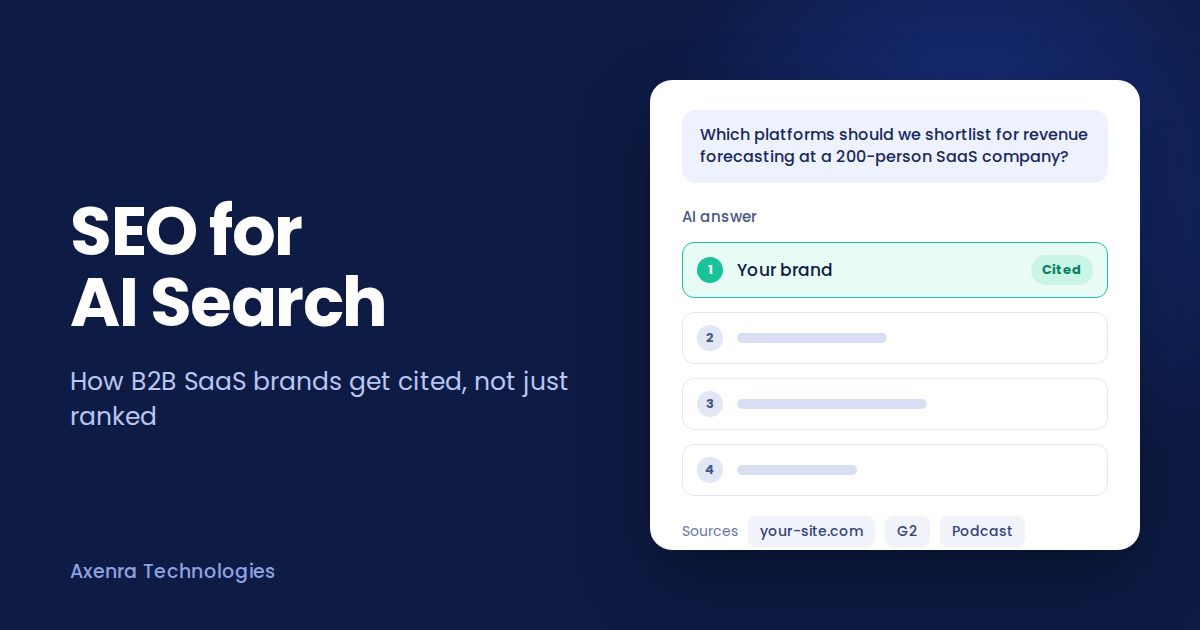
Imagine your next best-fit buyer opens an AI assistant and types: “Which platforms should we shortlist for revenue forecasting at a 200-person SaaS company?” Within seconds, she gets a tidy summary of four vendors, with reasons. If your brand isn't in that answer, you weren't rejected. You were never considered.
This is the quiet shift happening in B2B discovery. Ranking on page one still matters, but it is no longer the whole game. Increasingly, the question is whether AI systems understand you well enough to cite you.
This guide explains how SEO for AI search works for B2B SaaS, what generative engine optimization (GEO) actually asks of your content, and how to start with a realistic 60-day plan.
How B2B research is changing
B2B buying has always been a long, committee-driven process, but the early research stage has moved away from the search results page. Buyers now ask AI assistants to summarise categories, compare vendors and explain trade-offs before they ever click a website.
The Gartner 17% Rule
Gartner's widely cited buyer research found that B2B buyers spend only a small share of the buying journey, roughly 17% by its estimate, meeting with potential suppliers, and that is split across every vendor on the list. The rest happens independently: reading, asking peers, checking reviews and, more and more, questioning AI tools.
Three changes matter for marketing leaders:
Answers replace lists
Instead of ten blue links, buyers get a synthesised response. The brands named inside it capture the attention.
Shortlists form earlier
If you are absent from the first AI-assisted research session, you may never get a second chance.
Clicks aren't the sole metric
An AI answer can shape a decision without sending a single visit to your site.
For CMOs, MarTech directors and heads of growth, this means traditional SEO reporting (rankings, sessions, form fills) now captures only part of your real visibility.
What AI search systems need to understand and cite you
AI search tools, whether built into search engines or standalone assistants, generally do three things: retrieve relevant sources, interpret them, and compose an answer, often with citations. To be included, your content has to be easy to retrieve, easy to interpret and safe to trust.
In practice, that means AI systems look for:
Notice what is missing from that list:keyword density. Stuffing phrases into a page doesn't help a system that is trying to understand meaning.
Start with positioning: what you do for a specific who
The single biggest lever in generative engine optimization (GEO) is also the least technical: sharp positioning.
Vague copy such as “an all-in-one platform that empowers teams to unlock growth”gives an AI system nothing to work with. It can't tell what category you belong to, who you are for, or when to recommend you.
Vague (Ignored by AI)
“An all-in-one platform that empowers teams to unlock exponential growth.”
Sharp & Citable
“Acme is revenue forecasting software for B2B SaaS finance teams at 100–1,000 person companies, replacing spreadsheet-based pipeline models.”
Now a machine, and a human, knows exactly where you fit.
The Positioning Formula
[Company] is a [category] for [specific audience] that helps them [specific outcome] by [how you do it].
Then go one level deeper. Publish pages for each audience segment, use case and industry you genuinely serve. Specificity is what makes you the right answer to a specific question.
Structure answers clearly (headings, definitions, FAQs)
AI systems favour content that answers questions directly. You don't need to write for robots, only to write the way a good expert would explain something: clearly and in order.
Practical formatting habits
- Put a direct, two-to-three-sentence answer right under each question-style heading, then expand.
- Define key terms in plain language the first time you use them. (“Generative engine optimization is the practice of making your content easy for AI systems to understand, trust and cite in generated answers.”)
- Use descriptive H2 and H3 headings that match how buyers actually phrase questions.
- Add comparison tables, numbered steps and short lists where the content is naturally structured.
- Close important pages with an FAQ section covering real objections and questions from sales calls.
- Keep paragraphs short, with one idea each.
Structured content also serves human readers, which is the point. A page that is easy to scan, quote and trust performs better for people and for search systems.
Build topical authority, not keyword volume
Many B2B SaaS teams respond to every new search trend by publishing more: another listicle, another “ultimate guide”, another batch of AI-generated posts. The result is volume without authority.
Topical authority is the depth and coherence of your coverage of a subject. Instead of 50 loosely related posts, aim for a connected cluster:
One pillar page that thoroughly explains the core topic (e.g., “revenue forecasting for SaaS”).
Supporting pieces exploring sub-questions: methods, mistakes, benchmarks, tools, implementation.
Internal links that connect those pages logically, using descriptive, contextual anchor text.
Updated content, with visible review dates, so the cluster stays authoritative and current.
Thin, generic pages dilute that signal. If a page doesn't say anything a buyer couldn't get from five competitors, consider consolidating, improving or removing it. Fewer, stronger pages usually beat sprawling libraries.
Evidence and original insight
When an AI system must choose between ten similar pages, it favours sources that appear credible and distinctive. Evidence is what makes you citable.
High-value evidence for B2B SaaS includes:
- Original data: customer benchmarks, anonymised product usage trends, survey results.
- Case studies with specifics: the starting situation, what changed, measurable outcomes, timeframe.
- Expert commentary: named authors with relevant experience and visible credentials.
- Clear methodology: explain how you reached a conclusion so others can trust and reference it.
- Primary sources: cite reputable research and link to it rather than repeating unsourced claims.
You don't need a research department. A short survey of 50 customers, a transparent analysis of your own anonymised data, or a detailed teardown of a real project can all become the “original insight” other sources reference.
Consistency across your site, profiles and third-party mentions
AI systems don't rely on your website alone. They triangulate. If your site says you serve enterprise finance teams while your LinkedIn page says SMB marketers and a review site lists you in the wrong category, the picture gets muddy.
Audit and align:
- Your company description on the website, LinkedIn, Crunchbase, G2, Capterra and relevant directories.
- Category and use-case labels on review platforms.
- Founder and team bios, which support expertise and trust.
- Press mentions, partner pages and integration listings, which act as third-party validation.
- Technical foundations: descriptive page titles, clean site architecture, fast load times and structured data (schema markup) where appropriate.
Third-party mentions matter because they confirm, independently, what you say about yourself. Digital PR, partner co-marketing, analyst briefings and customer reviews are no longer “nice to have” brand activities. They feed AI visibility directly.
How to check your visibility
There is no single dashboard for AI search visibility yet, but you can build a practical picture with a few methods.
1. Manual prompt tests
Create a list of 20 to 30 prompts your buyers would plausibly use, covering:
- Category: “best [category] software for [audience]”
- Problem: “how do SaaS teams fix [problem]”
- Comparison: “[your brand] vs [competitor]”
- Brand: “what does [your company] do?”
Run them in the main AI assistants and AI-enabled search tools. Record whether you are mentioned, how you are described, which competitors appear and which sources are cited. Repeat monthly, since answers change.
2. Referral traffic
In your analytics, look for visits from AI assistants and AI search products in referral and source reports. The volume may be modest today, but the trend and the quality of those visitors are worth tracking.
3. Branded search
Growth in branded search queries and direct visits often follows increased visibility in places where buyers don't click. Watch branded impressions in Google Search Console alongside pipeline.
4. Self-reported attribution
Add a simple “How did you hear about us?” field to demo forms and ask sales to record the answer in your CRM. “ChatGPT”, “an AI tool” or “I searched and read a summary” are signals that no click-based report will ever show.
Mistakes to avoid
A 60-day roadmap
Establish Baseline & Customer Definition
- Write or refine your positioning statement and ideal customer definition.
- Run your baseline prompt tests and document the results.
- Audit key pages (home, product, about, top blogs) for clarity, structure and outdated claims.
- Add a self-reported attribution field to your forms.
Content Architecture & Data Markup
- Rewrite your top five commercial pages with direct answers, definitions and FAQs.
- Add or update structured data (Organization, Article and FAQ schema where relevant).
- Align company descriptions across LinkedIn, review sites and directories.
Pillar Clusters & Original Evidence
- Choose one core topic and publish or refresh a pillar page with three to five supporting articles.
- Create one piece of original evidence: a mini-survey, benchmark or detailed case study.
- Connect all pages with thoughtful internal links.
Third-Party Validation & Iteration
- Pursue three to five third-party mentions: partner posts, podcasts, industry roundups, customer reviews.
- Re-run your prompt tests and compare against the baseline.
- Review branded search, referral traffic and self-reported sources, then decide what to scale.
The goal at day 60 isn't dominance. It is a clearer, more consistent, better-evidenced presence, plus a measurement habit you can build on.
Frequently Asked Questions
What is generative engine optimization (GEO)?▾
Is GEO different from SEO?▾
How do AI tools decide what to cite?▾
How can I check what AI says about my company?▾
Does schema markup help?▾
Ready to see how AI describes your brand?
Axenra Technologies helps B2B SaaS companies build SEO and content strategies around specific positioning, structured answers and real evidence, so you are cited, not just ranked.
Run a free AI-search visibility check with us